AI for Independent Hotels: Where to Start, What to Prioritise and What to Ignore
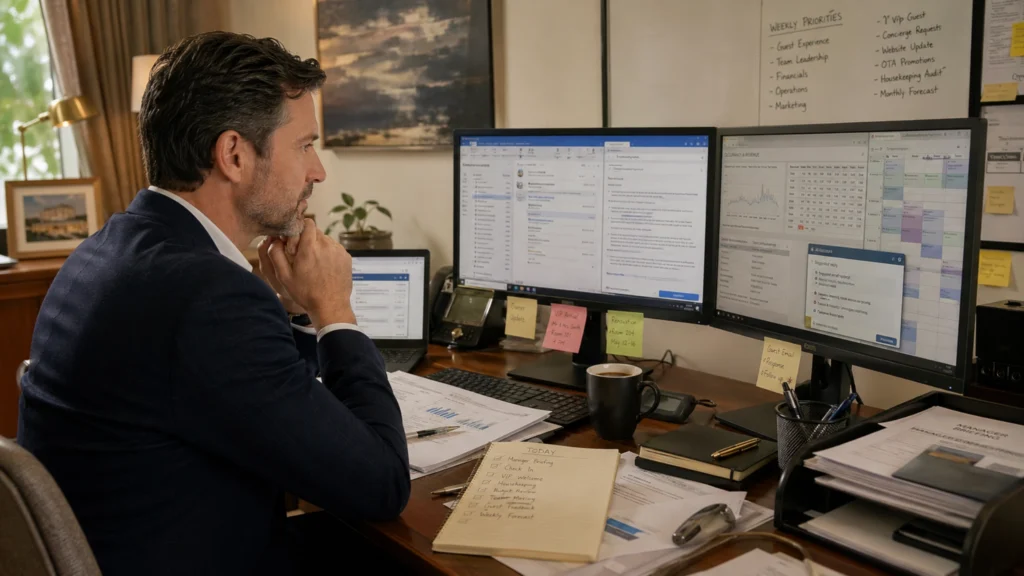
That number came from a recent industry survey and it does not surprise me at all.
In almost every conversation I have with independent hotel owners and GMs, the question is not whether AI is worth doing. It is where on earth to begin. There are dozens of vendors, hundreds of articles, and a constant stream of features being added to existing systems. The signal is buried under the noise, and the result is that a lot of independent hotels end up doing nothing, or doing too many small things at once with no plan behind them.
If you have decided AI matters for your hotel but are not yet sure how to act on it, the aim here is to be honest about where to start, what to prioritise once you have started, and what to leave alone for now. Not the vendor view. The view from inside the rooms where independent hotel teams describe where their time really goes.
01
Why independent hotels find AI harder to start than chains do
If you run an independent hotel and AI feels harder to get a handle on than it should, that is not a reflection of your ambition or your appetite for change. It is a reflection of your circumstances.
Chain hotels have dedicated technology teams. They have centralised IT budgets, group-level vendor relationships, and people whose entire job is to evaluate, implement, and manage new platforms. When a chain decides to roll out an AI capability, there is infrastructure behind that decision. Someone owns it. Someone funds it. Someone is accountable for whether it works.
Independent hotels do not have that. The owner or GM is often also the de facto technology decision-maker, the change manager, and the person who has to explain to the team why things are being done differently. The budget for technology sits alongside every other operational cost and gets weighed against all of them. And the systems already in place, the PMS, the revenue management tool, the accounting software, the housekeeping platform, were often adopted independently of each other. While most modern systems are designed with integration in mind, the reality is that gaps remain, and in an independent hotel without dedicated IT resource, those gaps tend to stay open.
Research reflects this clearly. Around 41% of independent hotels are already using AI in some form, with a further 16% planning to adopt it. But the honest picture behind that number is that most of what is being deployed sits at the visible, guest-facing end. Chatbots. Content generation. Review responses. The back-office and operational gains, where the most significant time savings actually live, remain largely untouched.
That gap exists not because independent hoteliers are unaware of the opportunity. It exists because the starting point is genuinely less obvious when you are working without the infrastructure that makes these decisions easier for larger organisations.
Understanding that is the first useful step.
02
The mistake most independent hotels make when they do start
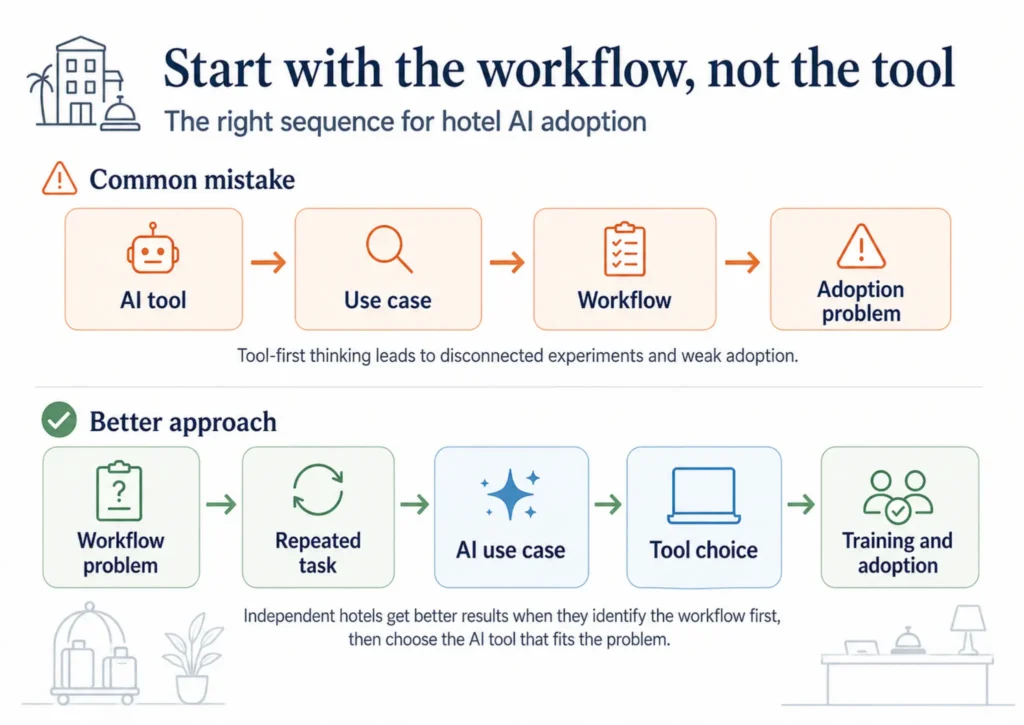
When independent hotels do decide to act on AI, the most common mistake is jumping straight to tools before understanding the problems they are trying to solve.
A chatbot gets installed. A pricing tool gets trialled. Someone in marketing starts using an AI content assistant. Each decision feels reasonable in isolation. But none of it was chosen as part of a plan, none of it connects to anything else, and within a few months the momentum quietly stalls. The tools that were going to change everything are either underused, misused, or abandoned.
I have seen a version of this play out repeatedly. A property adopts two or three AI capabilities within a short space of time, each one addressing a different problem for a different department. The staff feel uncertain about them. The data going in is inconsistent. Nobody is quite sure who owns the outcomes. And the owner or GM, who was genuinely enthusiastic at the start, ends up more sceptical about AI than they were before they began.
The reason this happens is straightforward. AI adoption in hotels gets treated as a product decision when it should be treated as an operational decision. The question is which problems are costing your team the most time, whether those problems actually have AI solutions, and in what order it makes sense to address them.
The question of which tools are worth using is valid, and we will get to it. But it is the second question, not the first. Start with the problem. Everything else follows from that.
Not sure where to start with AI in your hotel?
03
What I found walking into independent hotels
When I sit down with department heads at an independent hotel, the conversations follow a pattern I have come to recognise quickly.
It does not matter much whether the property has eighty rooms or a hundred and fifty. Whether it is a country house hotel or a city boutique. The operational picture that emerges, department by department, tends to look remarkably similar. Capable teams. Real pride in the guest experience. And underneath all of it, a quiet accumulation of manual workarounds that everyone has long since stopped questioning because they have always been there.
A recent discovery day I conducted at an independent hotel in the UK brought this pattern into sharp focus. Before I arrived I already knew the property was running around twenty different software platforms. What I did not know was how that looked in practice for the teams using those systems day to day.
I spent the day in back-to-back sessions with almost every department head. Each one described their own world clearly and honestly. Reports assembled manually each week because that was the reliable route. Data copied from one system into another by hand because a proper integration had never been scoped or funded. Communications written from scratch each time because no shared template or prompt library existed.
None of it was carelessness. It was pragmatism built up over years.
What I consistently find on days like this is the same pattern. Each department describes their friction in isolation, with no awareness that the team next door raised an almost identical problem an hour earlier. It is only when you sit with the full picture at the end of the day that it becomes visible.
That pattern is not a story about one hotel doing things wrong. It is a story about an entire sector carrying a weight it has normalised. And it is precisely why the question of where to start with AI is harder to answer than most vendors will admit. You cannot answer it sensibly until you understand what is actually happening across the whole operation. Not the version in the software brochure. The version the department heads describe when you ask them where their time really goes.
That diagnostic view is where every useful AI conversation in this sector has to begin.
04
Where to actually start (The honest answer)
"It should always start with the business problem you want to solve."
The best starting point for AI in an independent hotel is a repetitive workflow where staff are already copying, drafting, summarising, checking or reformatting information. The aim is to find one visible operational problem, improve it, and use that early success to build confidence across the team.
Where is your team losing time every week on work that is repetitive, manual, or templatable?
That question will tell you more about where AI can add genuine value in your operation than any product demo. In practice, that means looking for three things. Tasks that repeat on a predictable cycle, daily, weekly, or monthly, and produce broadly the same output each time. Processes that involve taking information from one place and moving it to another, reformatting it, or copying it across systems by hand. Communications that follow a consistent structure but get written from scratch every time because nobody has built a shared starting point.
Where you find those three things together, you have found a credible starting point.
What hotel processes are best suited to AI automation?
The strongest candidates are processes that are repetitive, follow a consistent structure, and currently consume meaningful time. The specific examples vary by department, but the pattern is consistent across almost every independent hotel I have worked with. A sales team spending significant time reformatting the same enquiry information for different proposal templates. A reservations team drafting responses to routine questions that are asked in slightly different ways dozens of times a week. An accounts team manually extracting data from one system and re-entering it into another because the two platforms have never been properly connected. A manager assembling a weekly report by pulling figures from three different sources and building it in a spreadsheet from scratch each time.
None of these are glamorous AI use cases. But they are the ones that prove value quickly, build confidence in the team, and create the foundation for more ambitious work later.
Do I need a large budget to start using AI in my hotel?
No. Most of the highest-value early opportunities can be addressed with general-purpose AI capabilities that cost a few hundred pounds per month at most, plus the time required to set them up properly. The larger investment is in the diagnostic work to identify the right starting points and the change management to ensure the team actually uses what has been set up. Licensing is rarely the constraint.
The instinct to start with something more transformative is understandable. But in an independent hotel, where teams are lean and tolerance for disruption is low, visible early wins matter more than ambitious long-term bets. Get one thing working well. Let the team see it. Then build from there.
05
What to prioritise once you have a starting point
Prioritise first
Leave until later
Repetitive enquiry replies
Full guest personalisation
Proposal generation from standard inputs
Predictive guest behaviour modelling
Review response support
Automated complex decision-making
Weekly report summaries
Deep system integration across every platform
SOP and internal knowledge support
AI projects dependent on clean unified data
Tone of voice and communication consistency
Vendor features sold mainly on roadmap promises
Once you have identified a starting workflow, the next question is how to sequence everything else. Not all AI opportunities in an independent hotel are equal. Some deliver visible time savings within weeks. Some require foundations to be in place before they can work properly. Some are genuinely transformative but only make sense after the simpler things are running.
A practical way to think about this is to group opportunities into three categories.
The first covers tasks that repeat on a predictable cycle and currently consume meaningful time. Drafting responses to routine enquiries. Generating proposals from standard inputs. Producing weekly or monthly reports. Writing pre-arrival or post-stay communications. Responding to online reviews. These should come first because the payoff is immediate, the disruption is minimal, and the team can see the difference quickly.
The second covers consistency. The way information is presented across the business, the tone of voice in guest communications, the quality of internal documentation, the structure of proposals going out from sales. Independent hotels live or die on the coherence of their brand and their operation, and AI is unusually good at helping a small team maintain that consistency at scale. These opportunities tend to require slightly more thought to set up properly, but they pay back over a long period and across multiple departments.
The third covers the more ambitious applications. Anything that involves analysing guest behaviour at scale, personalising at an individual level, or automating decisions that currently rely on human judgement. These are real opportunities, and the published case studies tend to focus on them. But they almost always depend on having clean data, connected systems, and a team that has already built confidence with simpler applications. Starting here, before the foundations are in place, is one of the most reliable ways to lose momentum.
Most independent hotels have more than enough in the first two categories to keep a structured AI programme busy for a year. The third category becomes accessible later, and by the time you reach it, the team will be ready for it.
06
Understanding what you are actually evaluating
What AI tools are most useful for independent hotels?
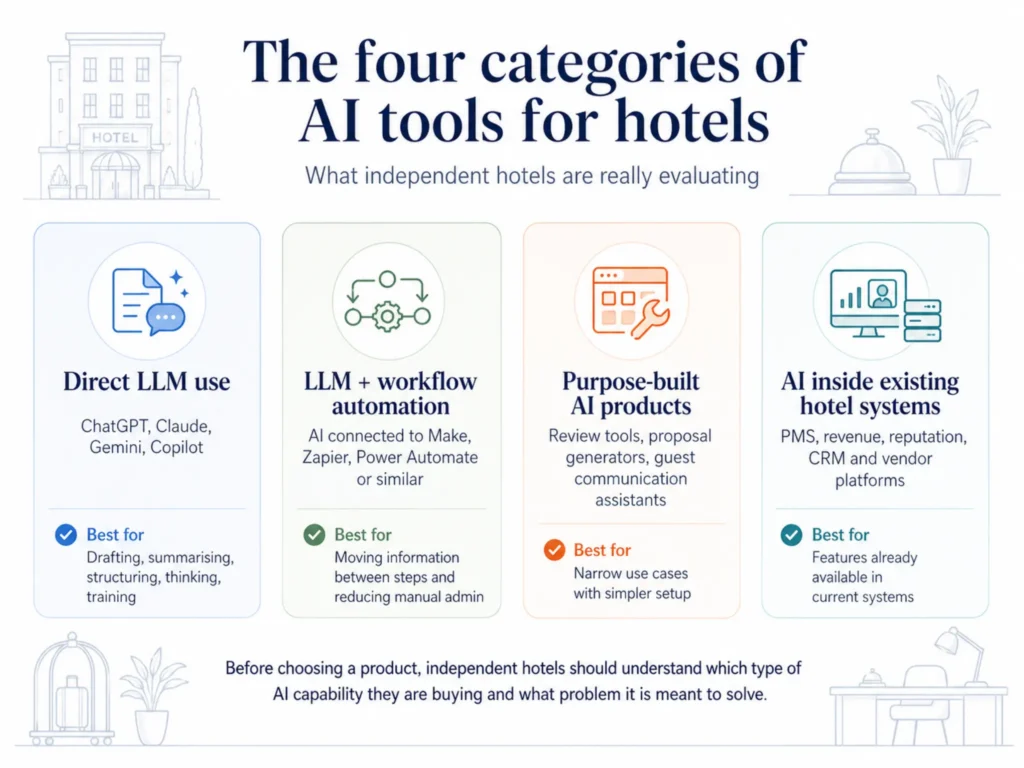
The answer depends entirely on where you are starting and what problems you are solving. Before evaluating any specific product, it helps to understand the four broad categories of AI capability available to hotels right now.
Category one: Large language models used directly
ChatGPT, Claude, Gemini, Copilot. Accessed through a chat interface, these are flexible, general-purpose tools that can be directed at almost any task. The user shapes the output through prompting. Most independent hotel staff are already here, usually on free versions, with no shared setup and no consistency across the team. Moving to paid versions and building a structured approach around these tools is often the highest-value early step.
Category two: LLMs combined with workflow and partial automation
This is where an LLM is combined with a workflow layer, using tools like Make or Zapier, to move information between steps without manual intervention. An enquiry arrives by email, an LLM structures it, the structured data gets written to a spreadsheet, and a notification goes to the relevant person. This is where meaningful operational automation begins, and it is more accessible than most independent hotel owners realise.
Category three: Purpose-built products wrapping an LLM
Software products built on top of an LLM for a specific narrow use case. A review response tool. A proposal generator. A guest communication assistant. The advantage is simpler setup and more constrained, predictable output. The limitation is that the use case is fixed. These products vary significantly in quality, and this is the category where vendor marketing most often outruns actual capability. Evaluate what a product does today, not what it promises to do on its next release.
Category four: AI baked into existing core software
The platforms hotels already use, Opera Cloud, Duetto, ReviewPro, and others, where the vendor has added AI features to existing functionality. This AI is often passive, running in the background to improve forecasting, flag anomalies, or surface recommendations. Some features are user-configurable. Many hotels are paying for this capability without knowing it exists. An audit of what is already available within your current tech stack is almost always worth doing before investing in anything new.
Want to see how this works in practice?
07
What to ignore
What should independent hotels avoid when adopting AI?
Not everything being marketed as AI for hotels deserves your attention right now. Some of it is genuinely useful but premature for where most independent properties currently sit. Some of it is vendor noise dressed up as innovation.
A few categories are worth setting aside, at least for now.
Anything that depends on clean, unified guest data you do not yet have. Personalisation at scale, predictive recommendations, behavioural targeting. These are real capabilities, but they assume a data foundation that almost no independent hotel has in place. Investing in capabilities that need that foundation before building the foundation itself is one of the most common ways AI budgets get wasted.
Anything that promises to replace human judgement on complex decisions. Pricing decisions that involve event context, group bookings, or reputational considerations. Guest recovery situations. Sensitive operational calls. AI can assist with these by surfacing information and offering recommendations, but the technology is not yet at the point where it should be making the final call unsupervised.
Anything in category three, the purpose-built wrapper products, being sold primarily on roadmap promises rather than current functionality. This is the part of the market where the gap between what is marketed and what is delivered tends to be widest. The question to ask any vendor in this space is simple: what does this do today, in its current version, for a hotel like mine? If the answer leans heavily on what is coming, that is worth noting.
Anything that requires deep integration between systems where the integration cost would outweigh the benefit. Not every workflow needs to be automated end to end. Sometimes the right answer is a partial solution that handles the manual work, leaves the systems alone, and saves significant time anyway.
AI should make someone’s working week easier quickly. If it cannot do that within a single operating season, it is either the wrong solution or the wrong moment for it.
08
A Note on System Integration Versus AI
Hotel system gaps do not all need the same solution. Some need proper integrations. Some can be handled with lighter workflow automation. Some are exactly where AI can help.
At one end, dedicated integration platforms and APIs are the architecturally clean solution when two systems need to exchange data continuously and accurately. That is an engineering problem and it has engineering solutions. At the other end, AI can bridge gaps that integrations either cannot cover or cannot economically justify covering. And in the middle, there are hybrid approaches where AI adds an intelligence layer on top of a partial integration, handling the interpretation and structuring work that data transfer alone cannot do.
Can AI help when hotel systems do not talk to each other?
Yes, in specific ways. AI cannot replace a dedicated integration where one is genuinely needed. But it can do something integrations are not designed to do: interpret, structure, and act on unstructured information at the point where it enters a workflow. An enquiry arriving as a free-text email cannot be automatically parsed by an integration. An LLM can read it, extract the relevant fields, and write structured data to a spreadsheet or push it toward a downstream system. That is AI performing the intelligence work that sits between the human input and the system that needs to receive it.
There is also a practical reality worth acknowledging. Even with excellent integrations in place, gaps remain. There will always be edge cases, exceptions, and judgement calls that no off-the-shelf connector handles cleanly. Closing every one of those gaps with bespoke development is technically possible, but commercially unrealistic for most independent hotels. I genuinely believe AI is the most practical way to address those last-mile gaps, not as a replacement for integration where integration is the right answer, but as the affordable and flexible alternative when further integration cannot economically be justified.
09
What good AI adoption looks like in practice
Good AI adoption in an independent hotel does not look dramatic. It rarely makes a press release. It looks like a sales team spending less time reformatting the same information across different proposal templates. It looks like pre-arrival emails that used to take twenty minutes each now taking two. It looks like a weekly report that used to require an hour of manual assembly arriving in the GM’s inbox already drafted, ready to be reviewed rather than built from scratch.
The accumulation of those gains is what changes how a business actually operates. Not one transformative project that reshapes the whole hotel. A series of targeted improvements that, together, return meaningful time to the people who need it most.
The team signal matters as well. Tools that the team understands get used consistently. Tools that appear from nowhere or feel imposed get quietly abandoned. The training and adoption work alongside any implementation is rarely the part that gets discussed in vendor demos, but it is often what determines whether a capability delivers value or sits unused after three months.
How long does it take to see results from AI in a hotel?
It depends on the use case. For some workflows the value is immediate. Drafting an email, structuring an enquiry, summarising a long document, these can save time on the first day a capability is used. For more involved workflows that require setup, prompt design, or team training, the typical window is one to six months. The approach that tends to fail is adopting multiple capabilities at once with no plan and waiting for transformation. The approach that works is starting with one workflow, proving the value quickly, and building from there.
There is also a quieter benefit that builds over time. As more workflows are improved, the team starts to see AI as a normal part of how work gets done rather than a separate initiative requiring special effort. That shift in perception is what allows the more ambitious applications to land later, when the foundations are ready for them. Without it, every new capability feels like another disruption.
AI adoption is not a project with an end date. It is an evolving operational capability. The independent hotels doing it well are treating it that way, and the difference shows up not in any single dramatic outcome but in how the operation feels to run, month after month.
10
Where to go from here
The starting point for AI in an independent hotel is a clear picture of where your team is losing time, which problems repeat across the operation, and which of those problems AI is genuinely the right answer for. That clarity is what makes everything else possible.
This diagnostic view is what separates AI adoption that builds momentum from AI adoption that stalls. The independent hotels getting real value from AI are the ones choosing deliberately, sequencing the work sensibly, and treating it as an evolving capability rather than a single project. That approach is available to any hotel, regardless of size or budget, but it requires starting in the right place.
If you are an independent hotel owner or GM trying to work out where AI fits in your operation, the right first step is a practical AI discovery conversation. We help independent and boutique hotels move from AI confusion to a clear, prioritised plan.
Ready to work out where AI fits in your hotel?
AI for your hotel
IN THIS POST

Manu Kastia
Manu Kastia is Founder and AI consultant at Digital Dialog, an AI consultancy specialising in tourism, travel and hospitality. With over 15 years of experience, Manu's expertise encompasses AI strategy, training, and advisory services for the sector. He has successfully worked with major brands including Switzerland Tourism, British Airways, Eurostar, Tourism Ireland, and Marketing Manchester. Manu's passion for making AI practical and accessible has positioned him as a sought-after speaker at industry events and a trusted consultant for organisations across tourism, travel, and hospitality. He helps businesses navigate AI decisions through strategic advisory, hands-on training, and comprehensive AI literacy resources. Manu has played a pivotal role in advancing AI knowledge through training sessions and strategy consulting, empowering professionals to harness AI for genuine business outcomes. His extensive sector background and practical approach make him a trusted advisor for those looking to navigate AI opportunities with confidence.