AEO, GEO, and AI Overviews Explained: A Beginner’s Guide for Hotels and Travel Businesses

AI-referred traffic to travel websites grew 3,500% year on year in 2025. Not 35%. Not 350%. Three thousand, five hundred percent. And yet the vast majority of hotels, tour operators, and travel businesses have no strategy for it.
If you have been hearing the terms AEO, GEO, and AI Overviews lately and are not entirely sure what they mean, you are not alone. These are relatively new concepts and the industry conversation around them has moved fast. What this post will do is explain each one clearly, in plain language, with examples grounded in travel and hospitality, and give you a clear sense of what the right response looks like.
01
What has actually changed in search
For most of the past two decades, appearing online meant one thing: ranking on Google. You published content, optimised it for keywords, built authority, and hoped to appear on page one. The goal was a click. The measure of success was traffic.
That model is still relevant. But something significant has been added on top of it, and it is changing the shape of how people discover travel brands, hotels, and destinations.
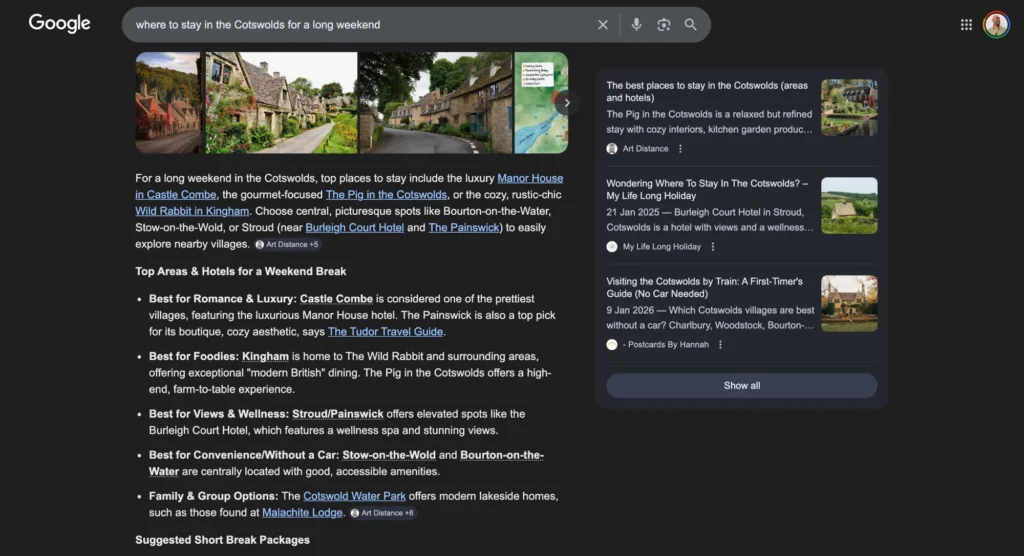
When someone now searches for “best boutique hotels in Edinburgh” or “where to stay in the Cotswolds for a long weekend”, they increasingly receive a synthesised answer. Not a list of blue links to click through. An actual answer, generated by an AI, that summarises options, makes comparisons, and in many cases gives a recommendation. The user may never visit your website at all. Their first impression of your brand is formed inside an AI response.
Booking.com research across 37,325 respondents in 33 markets found that 67% of travellers have already used AI in some aspect of travel planning. Among Millennials and Gen Z, adoption reaches 60% or higher. Deloitte’s Holiday Travel Survey found that GenAI usage for trip planning tripled from 8% in 2023 to 24% in 2025.
The shift is happening. Most hospitality businesses have not yet responded to it.
02
What is AEO?
Answer Engine Optimisation
AEO stands for Answer Engine Optimisation. It refers to the practice of structuring and presenting your content so that AI-powered answer engines can extract it, understand it, and present it as a direct answer to a user’s question.
An answer engine is any AI tool that responds to a question with a synthesised answer rather than a list of links. ChatGPT, Perplexity, and Google’s AI Mode all operate this way. So does Gemini. The user asks a question. The engine produces an answer.
AEO is about being the source that answer engine draws from.
What does this look like in a travel context?
Imagine a prospective guest types into ChatGPT: “What is the best family-friendly hotel in the Lake District with a pool and easy access to hiking?” The AI does not return ten links. It returns an answer, possibly naming two or three properties, explaining what makes them suitable, and potentially including where to book.
If your hotel appears in that answer, you have been cited by an answer engine. If it does not, you are invisible to that user at that moment, regardless of how well your website ranks on Google.
AEO is the practice of making your content structured, direct, and clearly answerable, so that AI tools can pull from it with confidence. This means writing in a way that addresses specific questions plainly, FAQ content that uses natural conversational language, and content that does not require an AI to guess at what you are saying because you have said it clearly.
The practical difference from traditional SEO
Traditional SEO was about getting humans to click your link. AEO is about getting an AI to trust your content enough to cite it. A page optimised purely for keyword density may not be the same page that an AI engine finds credible and extractable. AEO requires concise, specific, well-structured answers to real questions that your potential guests are asking.
Not sure where your business stands in AI search?
03
What is GEO?
Generative Engine Optimisation
GEO stands for Generative Engine Optimisation. Where AEO focuses on getting direct answers extracted from your content, GEO focuses on something slightly broader: making your brand trusted, credible, and consistently cited across the generative AI landscape.
Generative AI models do not just search the web in real time. They are trained on vast bodies of content and draw on that training to form responses. They also pull from external sources when generating answers. GEO is about ensuring that when an AI model constructs a response about travel, hotels, or your specific category, your brand is represented accurately, positively, and frequently.
What does this look like in a travel context?
GEO is why it matters that your hotel is mentioned in authoritative travel publications, that your brand appears in review platforms, that your content is distributed beyond your own website, and that the information about you across the web is consistent and accurate. AI models form their understanding of your brand from all of these signals together, not just your own homepage.
Research from Cloudbeds, analysing AI responses across ChatGPT, Perplexity, and Gemini for 145 properties, found that 98% of AI-recommended hotels appeared on YouTube, 97% in travel blogs, and 95% on Reddit. Your off-site presence is not peripheral to GEO. For many AI models, it is more important than your website itself.
The difference between AEO and GEO
Think of it this way. AEO is about whether a specific piece of your content is structured well enough for an AI to extract and cite it. GEO is about whether your brand has the broader digital presence and authority that causes AI models to include you in their responses in the first place. You need both. AEO without GEO means your content is well-structured but nobody trusts it. GEO without AEO means your brand is known but your content is hard to extract and cite.
04
What are AI Overviews?
Google’s AI-generated summaries in search results
AI Overviews (often abbreviated to AIO) are a specific Google feature. When you search on Google, you may now see an AI-generated summary appearing at the top of the results page, above the traditional blue links. That summary is an AI Overview.
Google uses its Gemini model to generate these summaries. They appear selectively, when Google’s system determines they add value to the search. AI Overviews now appear in 25% of all search queries. In the healthcare sector they appear in nearly 50% of queries. Travel sits in between, but the presence is significant and growing.
Why does this matter for hotels and travel businesses?
When an AI Overview appears on a search results page, click-through rates to the traditional organic results drop significantly. Research indicates that organic results receive only 8% of clicks when an AI summary is present. For a hotel or travel brand that has invested in SEO to reach page one, this is a meaningful change. The traffic that page one used to deliver is being partially captured by the AI Overview itself.
But there is also an opportunity. If your content is cited within an AI Overview, you gain visibility in a position that sits above traditional search results entirely. You are no longer competing just for the top organic spot. You are competing to be the source that Google’s AI draws from.
What kinds of content get cited in AI Overviews?
Google draws AI Overview citations primarily from blog content, articles, video content, news content, and product pages. The content that performs well tends to be helpful, well-structured, and clearly answering a real question. And critically, it does not need to be the most-visited or highest-ranking page. This is genuinely significant for brands that have been consistently outranked by OTAs and aggregators.
One important clarification
AI Overviews are a Google-specific feature. AEO and GEO are broader disciplines that apply across all AI search platforms: ChatGPT, Perplexity, Gemini, Copilot, and others. Optimising for AI Overviews is a specific application of AEO and GEO principles within Google’s ecosystem.
05
How AEO, GEO, and AI Overviews relate to each other
These three terms describe overlapping but distinct aspects of the same broader shift.
Answer Engine Optimisation
Generative Engine Optimisation
AI Overviews
AEO is about content structure and directness. Can an AI extract a clear, accurate answer from this specific page?
GEO is about brand authority and presence across the web. Does this brand appear across enough trusted sources that AI models include it in responses?
AI Overviews are a specific feature within Google Search. They are where AEO and GEO principles play out within Google’s results page.
None of these replace traditional SEO. A strong SEO foundation, well-indexed content, a technically sound website, consistent structured data, still underpins all of it. The difference is that it is no longer enough on its own. A hotel that ranks well on Google but has no broader digital footprint, no YouTube presence, no editorial coverage in travel publications, inconsistent information across review platforms, will find itself increasingly invisible in the places where travellers are now beginning their search.
06
Why this matters specifically for travel and hospitality
"New front doors are going to be created. From a supplier perspective, that's an opportunity to change the dynamic that's existed for the past 20 years."
Every sector is affected by this shift. But travel and hospitality face a particular version of it.
The industry has already spent two decades watching OTAs such as Booking.com and Expedia capture distribution. Direct bookings have been under pressure since online travel agencies mastered Google SEO and paid search. AI search introduces a new layer of that same dynamic. OTAs currently account for 55.3% of all AI-generated travel citations, according to Cloudbeds’ 2025 study. They are well-structured, data-rich, and consistent across millions of listings. AI models find them easy to cite. For a tactical look at how properties can reclaim this visibility, read our deep dive on AI search for hotels.
The signals that AI models reward are not identical to the signals that drove OTA dominance in traditional search. OTAs won SEO through backlink profiles and domain authority. AI models weigh different factors: structured data quality, editorial coverage in travel publications and blogs, review sentiment and volume, content freshness, and consistency of information across multiple platforms. These are areas where individual hotel brands, especially those with distinctive identities and genuine guest relationships, can compete.
There is also a quality argument for acting now. Traffic arriving via AI citations is not the same as traffic arriving from a generic Google search. Multiple studies place AI-referred visitors as between four and five times more likely to convert than traditional organic visitors. This is because the AI has already done much of the research and qualification on the user’s behalf. By the time someone clicks through, they already know what they are looking for.
The challenge for hospitality businesses is that the window to establish visibility in AI search is narrowing. Citation patterns, once formed, are proving remarkably stable. BrightEdge data shows that 96.8% of cited domains in AI responses show no change week to week. The brands appearing in AI responses now are the brands compounding their advantage.
07
What Digital Dialog found when we tested this ourselves
Rather than rely solely on published research, we have been running our own tests. As part of client work, we recently conducted a detailed AI visibility audit for a UK cruise and travel operator, testing real consumer queries across ChatGPT, Gemini, Perplexity, and Google AI Mode. The findings were instructive.
The first thing we found is that AI visibility is platform-specific in ways that are not obvious. The same brand, tested with the same query, produced completely different results depending on which AI tool was used. On ChatGPT the brand appeared with a broadly accurate description and was cited directly. On Gemini, which is Google’s AI and increasingly the platform travellers encounter first via search, the same brand was entirely absent for the same queries. Competitors appeared. The brand in question did not exist as far as Gemini was concerned.
The second finding was about distribution. When AI tools did recommend the brand, they frequently sent the user to third-party booking agents rather than to the brand’s own website. The booking channel, in other words, was being captured by intermediaries, not by the brand that owned the product. This is the AI equivalent of the OTA problem that has cost the industry billions in commission over the past two decades.
The third finding was about product-specific content. The operator had a premium, niche product with very limited competition. When we searched for it across all AI platforms, it was virtually invisible, despite being exactly the kind of specific, unusual offering that AI tools are well-suited to recommend. The problem was not the product. The problem was the absence of the structured, extractable content that AI tools need in order to cite it.
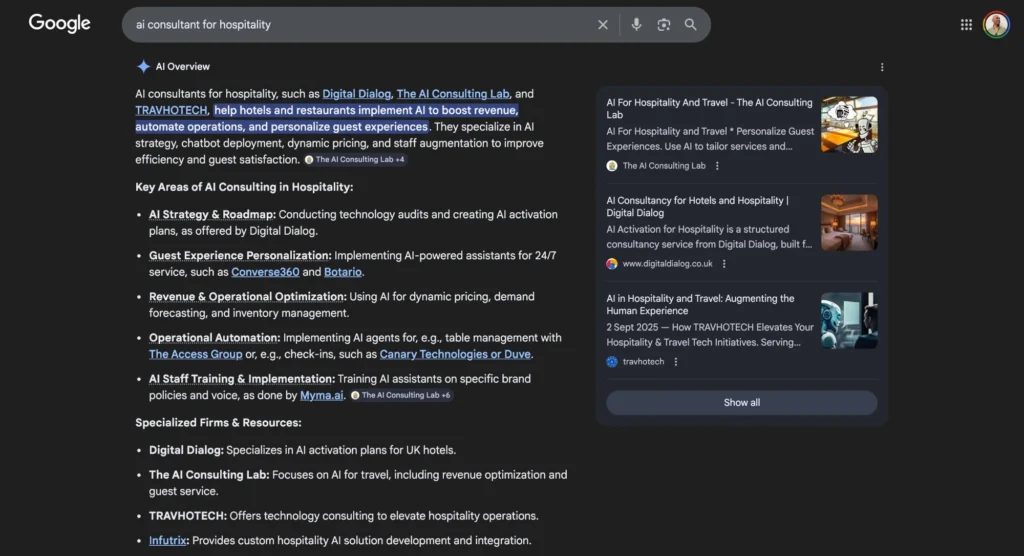
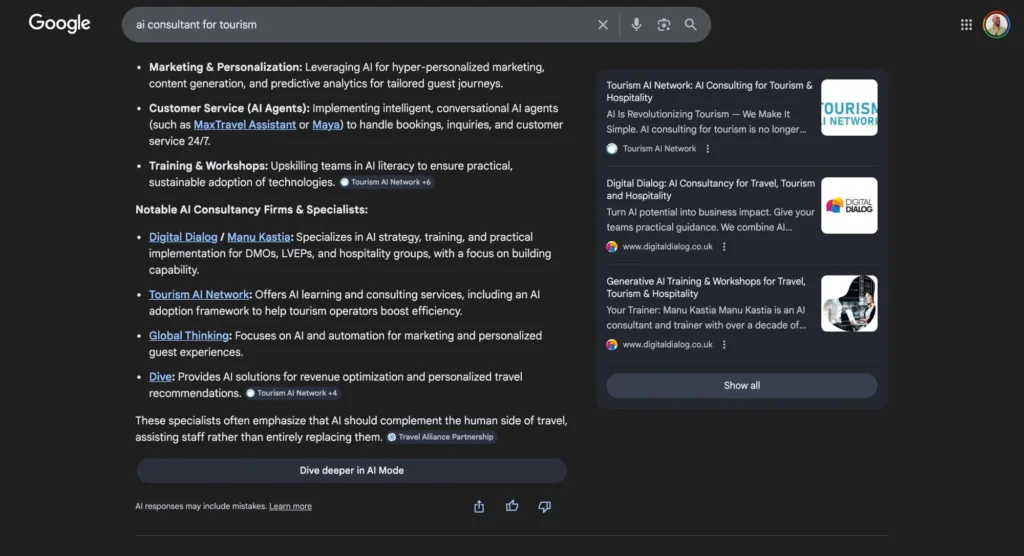
We now apply this methodology to travel and hospitality businesses across the UK and Europe. The process begins with understanding exactly where a brand currently stands in AI search, platform by platform, and builds from there.
08
What good practice looks like: a high-level orientation
This post is not the place for a detailed how-to guide but it is worth giving you a clear sense of direction before we go deeper.
Preparing your travel or hospitality business for AI search visibility broadly involves four areas.
1. Content that answers real questions clearly
The content AI models cite most reliably is content that directly addresses specific questions in plain language. For a hotel, this means pages that answer questions such as: what makes this property different, what is the experience actually like, what are the facilities, who is it best suited to. It means FAQ content written in natural, conversational language. It means content that stands on its own and makes sense even when taken out of context. For hotels specifically, we have put together a separate AI search guide for hotels that explains how to improve your chances of being recommended by ChatGPT, Gemini and Google AI Overviews.
2. Consistent, accurate information everywhere
AI models build their understanding of your brand from multiple sources simultaneously. If your address, amenities, room types, or pricing appear differently across your website, Google Business Profile, TripAdvisor, Booking.com, and other platforms, the AI has to make judgements about what is accurate. Inconsistency reduces confidence and can reduce citation. Consistency across all platforms is foundational.
3. A presence beyond your own website
AI models are heavily influenced by third-party sources. Editorial coverage in travel publications, mentions in travel blogs, appearances on YouTube, presence on review platforms, discussions in relevant online communities: all of these contribute to how an AI model perceives and represents your brand. A hotel whose entire digital presence is its own website is a hotel that AI models have little external evidence to cite. For hotel marketers and owners, our AI search guide for hotels goes deeper into the content, citation and off-site visibility signals that influence whether AI tools recommend your property.
4. Technical foundations that allow AI to crawl and understand your site
AI agents, like search engine crawlers, need to be able to access your content. Pages that are blocked, slow to load, or rely heavily on client-side rendering can be harder for AI models to process. Schema markup, structured data, and clean technical architecture all contribute to how well AI can read and use your content.
Not sure where your business stands in AI search?
Is your hotel or travel brand invisible in AI search?
IN THIS POST

Manu Kastia
Manu Kastia is Founder and AI consultant at Digital Dialog, an AI consultancy specialising in tourism, travel and hospitality. With over 15 years of experience, Manu's expertise encompasses AI strategy, training, and advisory services for the sector. He has successfully worked with major brands including Switzerland Tourism, British Airways, Eurostar, Tourism Ireland, and Marketing Manchester. Manu's passion for making AI practical and accessible has positioned him as a sought-after speaker at industry events and a trusted consultant for organisations across tourism, travel, and hospitality. He helps businesses navigate AI decisions through strategic advisory, hands-on training, and comprehensive AI literacy resources. Manu has played a pivotal role in advancing AI knowledge through training sessions and strategy consulting, empowering professionals to harness AI for genuine business outcomes. His extensive sector background and practical approach make him a trusted advisor for those looking to navigate AI opportunities with confidence.