AI labs need to stop chasing AGI and improve the products businesses already depend on.

· AI features and interfaces described here were current when this article was written and may change.
AI models are becoming astonishingly capable. The products wrapped around them are becoming unnecessarily complicated. For businesses paying to use AI every day, that balance needs to change.
When ChatGPT launched on 30 November 2022, the interface was almost comically simple.
There was ChatGPT. There were a few example prompts, a short explanation of what it could and couldn’t do, and a box at the bottom where you typed what you wanted.
That was pretty much it.
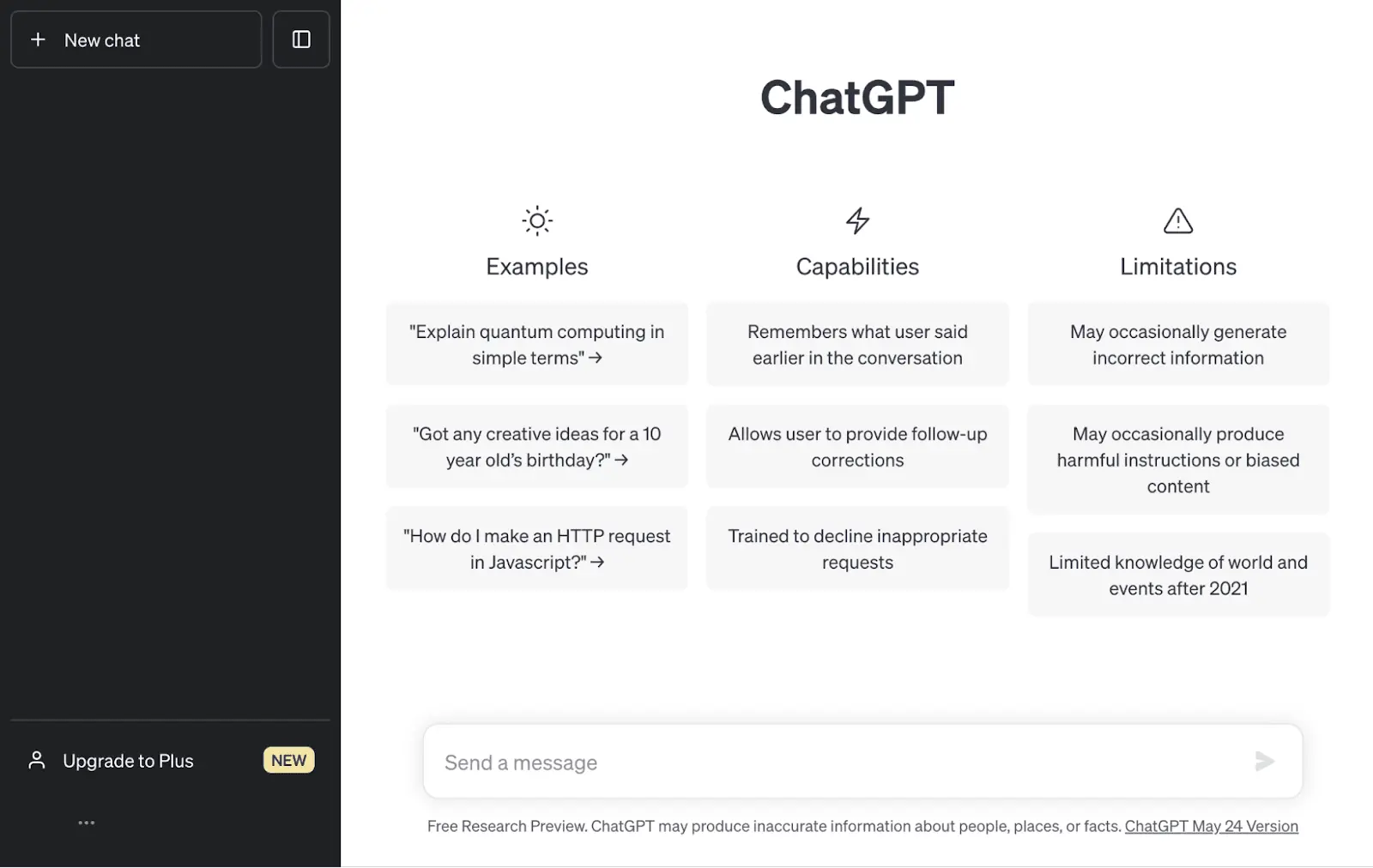
Now compare that with ChatGPT today.
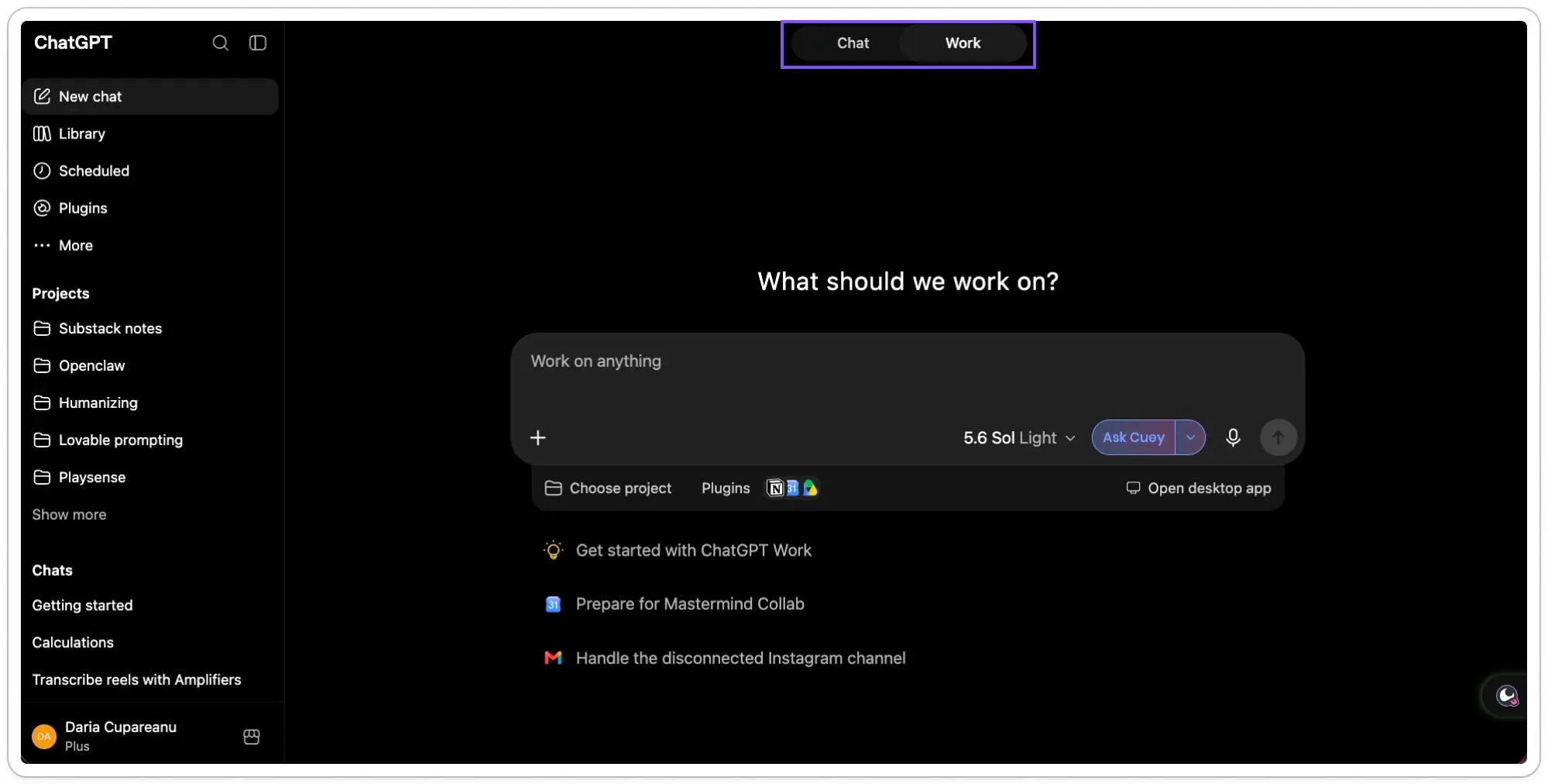
Four years later we have Chat, Work, Codex, Projects, Plugins, Skills, Agents, different models, reasoning levels, usage allowances, credits, settings and functionality that can vary according to the plan, workspace or interface you happen to be using.
Some increase in complexity is inevitable when a product becomes vastly more capable.
But good product design is supposed to manage that complexity for the customer.
Increasingly, AI companies are doing the opposite.
They are exposing the machinery.
And for businesses trying to get ordinary employees to use AI effectively, that is becoming a serious problem.
Businesses don’t buy AI models. They buy products.
OpenAI’s mission is explicitly centred on AGI. Its research operation describes itself as pursuing research “on the path to AGI”, and OpenAI says its mission is to ensure that AGI benefits all of humanity.
Fine. Keep pursuing it.
But the product experience businesses are paying for today needs a hell of a lot more attention.
The requirements I hear from businesses are considerably smaller than the ambitions surrounding AGI.
Can AI analyse this spreadsheet correctly?
Can it extract information from these enquiries?
Can it help us produce the weekly report?
Can it find the right information across our files?
Can it help develop a strategy?
Can it create a useful first draft?
Can it make this repetitive process faster?
Ultimately, businesses want to know whether AI will save time, improve performance and help people produce better work.
They don’t particularly care whether the latest model can solve another extraordinarily difficult mathematical problem, beat another benchmark or demonstrate some new form of reasoning that makes for a good launch presentation.
There is already an enormous gap between what current AI models are capable of doing and what most businesses are actually getting from them.
The immediate opportunity is to improve that.
Look at what has happened to ChatGPT
The visual comparison tells a large part of the story.
The original ChatGPT interface was almost ruthlessly simple.
Today, the underlying product has accumulated an extraordinary number of capabilities, but the interface and product architecture have struggled to absorb them.
The problem isn’t simply the number of features.
It is how rapidly things move, disappear, reappear somewhere else, get renamed or become reorganised.
Users on OpenAI’s own community have recently complained about changes to Projects, sidebar navigation and the way conversations are organised. In some cases, functionality users initially thought had been removed had simply moved somewhere else. OpenAI Support has itself confirmed that aspects of the Projects interface changed.
That distinction hardly matters to the user.
If someone reasonably thinks a feature has disappeared because they can’t bloody find it, you have a product design problem.
I experienced this myself this morning.
I wanted to access OpenAI’s Agents Studio. I knew it existed. Yet I couldn’t see it in my sidebar.
Eventually, I went directly to chatgpt.com/agents and accessed it that way.
I work with AI every day.
What happens to the hotel manager, sales executive, finance director or membership manager who uses ChatGPT for perhaps half an hour a day?
For them, undiscoverable functionality may as well not exist.
Ten years ago, product teams building serious business software would have been expected to spend considerable time testing changes to navigation and information architecture before releasing them widely.
AI labs increasingly seem to be shipping products with the change velocity of research software while simultaneously asking businesses to depend on those products for everyday work.
That is a bad combination.
“How much of my brainpower would you like me to use?”
There is another development across AI products that I find increasingly absurd: asking customers to decide how much reasoning the AI should apply.
I use a simple analogy when I train people.
Imagine you have a task for an employee.
You call them in and explain what you need.
They listen carefully, then reply:
“How much of my brainpower would you like me to use?”
You would look at them as if they had completely lost their mind.
Yet that is increasingly what AI products are asking us.
On ChatGPT’s paid plans, users can encounter choices including Instant, Medium, High, Extra High and Pro, depending on their plan and workspace settings. OpenAI explains that these controls determine how much thinking or reasoning the model applies.
Claude does much the same thing.
Anthropic currently lets users choose the model, select an effort level and, depending on the model, control thinking separately. Effort choices can include Low, Medium, High, Extra High and Max.
Google has joined in too.
Gemini lets users switch between models such as Flash-Lite, Flash and Pro, while supported plans can also choose thinking levels including Standard, Extended and Deep Think. Google even notes that more advanced models and higher thinking levels consume more usage.
So this is now an industry problem.
WTF? How is the user supposed to know how much reasoning effort a spreadsheet task requires?
Should developing a marketing strategy be Medium or High?
Does analysing a 40-page document need Extended Thinking?
Should I switch to Pro?
Is this an Extra High job?
Do I need Deep Think?
How the hell would I know?
And why should I know?
If I give an intelligent system a task, determining how much intelligence or computation that task requires should be part of the intelligence.
Just choose the damn model for me.
AI can apparently help us do everything except use AI efficiently
There is a wonderful irony in all this.
We now use AI to help us write, analyse, research, brainstorm, interpret numbers, develop strategies, create presentations and increasingly operate software on our behalf.
We are prepared to trust AI with some remarkably complicated work.
Yet before it begins, the human is still expected to decide which model should handle the task, how much reasoning it requires, which mode to use and sometimes whether the AI should “think” at all.
The AI can help me develop a business strategy, but apparently it needs me to tell it how much thinking the strategy requires.
Something is upside down here.
Imagine Google Maps asking which routing algorithm you would like before you enter your destination.
Most people have absolutely no interest in choosing the algorithm.
They want to tell Maps where they are going and arrive at the right place, at the right time.
AI should work the same way.
I should describe what I need.
The system should determine which model, reasoning level, tools and execution capability are required to get me there.
That is precisely the sort of decision AI should be making for us.
And then there is Chat and Work
OpenAI has created another completely unnecessary conceptual problem with Chat and Work.
Just think about those names for a moment.
The implication is that what happens in Chat somehow isn’t work.
If I’m brainstorming a commercial strategy with ChatGPT, I’m working.
If I’m analysing an enquiry, I’m working.
If I’m reviewing figures, developing an idea, writing a proposal or working through a difficult problem, I’m working.
But OpenAI has decided to call one part of the product “Chat” and another “Work”, largely because Work is intended for longer, more involved and multi-step tasks.
From the user’s perspective, the distinction is far less clear.
A lot of what people can do in Work can also be done perfectly well in Chat.
And most ordinary business users haven’t reached the point where they spend their days handing sophisticated autonomous multi-step assignments to AI agents.
They are still trying to make AI useful for normal everyday work.
So instead of helping them, we have introduced another question:
Should I do this in Chat or should I do this in Work?
OpenAI may have perfectly detailed internal definitions explaining the difference.
The customer shouldn’t need to learn them.
Quite simply, this is product design at its worst.
Claude created almost exactly the same problem
Anthropic went down a remarkably similar route with Chat and Cowork.
Again, the framing itself is odd.
Talking to AI, brainstorming, analysing and developing ideas are all perfectly legitimate forms of work. Calling the agentic part “Cowork” artificially separates one form of working from another.
Interestingly, Anthropic now appears to have recognised the problem.
Its current help documentation says:
“Claude Cowork is now just Claude.”
In the new experience being rolled out, users simply ask for what they need and Claude decides whether it should provide a quick answer or perform a task.
That is much closer to how these products should work.
The user expresses the intent.
The AI determines how to execute it.
OpenAI should do the same with Chat and Work.
Businesses pay the price for constant UI change
There is another reason all this matters more in business than it does with casual consumer software.
Businesses build processes around products.
When I train a team to use ChatGPT, Claude or Gemini, people need to remember where things are and how a workflow operates.
Organisations create internal guidance.
Screenshots go into training decks.
SOPs refer to particular functions.
Recorded sessions show employees where to click.
Workflows develop around Projects, files, connectors or other features.
Then the product changes.
A menu moves.
Projects suddenly behave differently.
A feature gets renamed.
A button moves behind another button.
A new mode appears.
The model selector changes again.
Every unnecessary change creates friction.
Someone has to explain it.
Someone has to update the guidance.
And employees who had finally become comfortable with a workflow have to relearn part of it.
This matters enormously when organisations are already struggling with AI adoption.
For many businesses, the challenge is no longer obtaining access to AI. It is getting employees to incorporate it consistently into their work.
Product instability makes that harder.
A mature business product has to recognise that interface stability has economic value.
The pressure to monetise AI makes good product design even more important
It isn’t difficult to understand why AI labs are moving at extraordinary speed.
The sums being invested in AI infrastructure are enormous.
OpenAI and its partners announced Stargate with an intention to invest $500 billion over four years in AI infrastructure in the United States.
Those investments eventually need an economic return.
AI companies need paying customers, increasing usage and recurring revenue.
Businesses should therefore be incredibly valuable customers.
Once an organisation properly embeds an AI product into its workflows, trains employees around it and starts building processes on top of it, that relationship could last for years.
But these customers also have choices.
If the product becomes frustrating, confusing or unpredictable, switching becomes increasingly attractive, particularly when competing models are already capable enough for most business tasks.
The AI labs are racing each other towards more capable intelligence.
They should pay far more attention to the race for customer experience.
OpenAI has actually articulated the right idea itself
The most ironic part is that OpenAI has already said something I completely agree with.
“Frontier capability is only part of the job. The bigger task is turning that capability into tools people can actually use to thrive.”
Exactly.
That bigger task now deserves far more attention.
For many business users, the next meaningful improvement will not come from another few percentage points on a benchmark.
It will come from a product that looks at the task and automatically determines which model is appropriate.
A product that decides how much reasoning is needed.
A product that understands whether something needs a quick response or a longer multi-step process.
A product whose navigation is stable enough for people to learn it.
A product where the sophistication sits behind the interface instead of being dumped in front of the customer.
What should AI companies do differently?
I would start with five things.
1. Hide the model architecture wherever possible
Most people should not need to know which model they are using.
Give advanced users access to those controls if they want them, but make automatic routing the normal experience.
The user describes the job.
The AI chooses the damn machinery.
2. Get rid of artificial divisions such as Chat and Work
A task is a task.
Sometimes AI will answer immediately.
Sometimes it will need to research something.
Sometimes it will need to access files or another application.
Sometimes it will need to carry out twenty steps and come back with a finished result.
The user should not have to decide which product mode that belongs in before they begin.
Anthropic’s move towards combining Chat and Cowork shows what this can look like.
3. Treat navigation stability as an enterprise requirement
Move things when there is a demonstrable improvement to the experience, not simply because another product team has redesigned the sidebar.
Businesses build training and processes around interfaces.
Stop moving the bloody furniture.
4. Use progressive disclosure
The person opening ChatGPT for the first time should see something remarkably simple.
As they become more advanced, more capability can become available.
The underlying system may contain dozens of models, agents, execution environments and specialist tools. That doesn’t mean the customer needs to see all of them.
5. Measure productivity as aggressively as intelligence
AI companies obsess over benchmarks for reasoning, maths, coding and scientific capability.
For business users, there is another benchmark that matters just as much:
Did this product help somebody do useful work faster and better?
That should be a fundamental measure of progress.
The AI race businesses actually care about
I am deliberately being provocative when I say AI labs should stop chasing AGI.
I am not suggesting they abandon frontier research.
I am saying there is already more than enough intelligence sitting inside these products to transform the productivity of millions of businesses.
We haven’t come close to extracting the value from what already exists.
Part of the problem is adoption.
Part of it is workflow design.
Part of it is training.
And increasingly, part of it is the products themselves.
As AI systems become more sophisticated, the user experience should become simpler.
The intelligence should absorb complexity, not create more of it.
Businesses don’t need AGI before lunch.
They need AI to read the spreadsheet correctly.
They need it to find the right information.
They need it to help someone do two hours of work in twenty minutes.
They need employees to understand how to use it without constantly wondering which model, mode or reasoning setting they were supposed to choose first.
Four years ago, ChatGPT’s proposition was remarkably simple:
Tell the AI what you want.
Perhaps the smartest thing the AI industry could do now is improve the products until we can get back to that idea.
Tell the AI what you need. Let the AI work out the rest.

Manu Kastia
Manu Kastia is Founder and AI consultant at Digital Dialog, an AI consultancy specialising in tourism, travel and hospitality. With over 15 years of experience, Manu's expertise encompasses AI strategy, training, and advisory services for the sector. He has successfully worked with major brands including Switzerland Tourism, British Airways, Eurostar, Tourism Ireland, and Marketing Manchester. Manu's passion for making AI practical and accessible has positioned him as a sought-after speaker at industry events and a trusted consultant for organisations across tourism, travel, and hospitality. He helps businesses navigate AI decisions through strategic advisory, hands-on training, and comprehensive AI literacy resources. Manu has played a pivotal role in advancing AI knowledge through training sessions and strategy consulting, empowering professionals to harness AI for genuine business outcomes. His extensive sector background and practical approach make him a trusted advisor for those looking to navigate AI opportunities with confidence.