Hotel AI Implementation Case Study: Sopwell House
How Digital Dialog is working with Sopwell House to identify, prioritise and implement practical AI opportunities across hotel operations.
- Client: Sopwell House
- Sector: Hotels and hospitality
- Location: St Albans, Hertfordshire
- Engagement: Hotel-wide AI consultancy and implementation
- Status: Implementation in progress
- Engagement commenced: April 2026
- Last updated: August 2026
The challenge at Sopwell House
Sopwell House approached Digital Dialog with a challenge that will be familiar to many hotels exploring AI.
Teams were already experimenting with tools such as ChatGPT, software suppliers were introducing new AI capabilities, and there was a clear sense that AI could improve efficiency across the business. What was missing was a structured view of where the strongest opportunities actually lay and how they should be implemented.
The hotel operates across a substantial technology stack covering property management, reservations, revenue, purchasing, finance, spa, restaurants and other areas of the operation. Many processes still involve staff moving information manually between systems, downloading reports, working in Excel, checking data across different platforms and producing recurring communications and management reports.
Sopwell House already had a working understanding of many of the operational pain points, but wanted an external perspective to assess the operation in detail and identify where AI would have the biggest impact, which opportunities were worth prioritising, and how new solutions could work alongside the systems already in place.
How we assessed the opportunity
The engagement began with an on-site AI Opportunity Discovery session at Sopwell House.
We met with the people responsible for nine areas of the hotel, with additional teams expected to be brought into the project as it progresses.
- Marketing
- Accounts
- Purchasing
- Revenue
- Reservations
- Sales and Events
- Housekeeping
- Front Office
- Spa
Rather than starting with a list of AI products or predetermined use cases, we worked through how each department actually operates.
The discussions focused on recurring tasks, manual processes, reporting requirements, communications, systems being used, information moving between platforms and the points where staff were losing time.
This gave us a hotel-wide view of the operation and allowed us to distinguish between several different types of opportunity.
Some problems were well suited to AI. Others were stronger candidates for traditional automation. Some depended on better access to data from an existing hotel system. In other cases, our first task was to establish whether functionality already available within the hotel’s software could solve part of the problem.
That distinction has been important throughout the engagement. We are designing around the operational requirement first, then determining the most appropriate technology.
What we found across the hotel
The departmental discussions produced a large number of individual opportunities, but the most useful finding was how often the same underlying patterns appeared in different parts of the hotel.
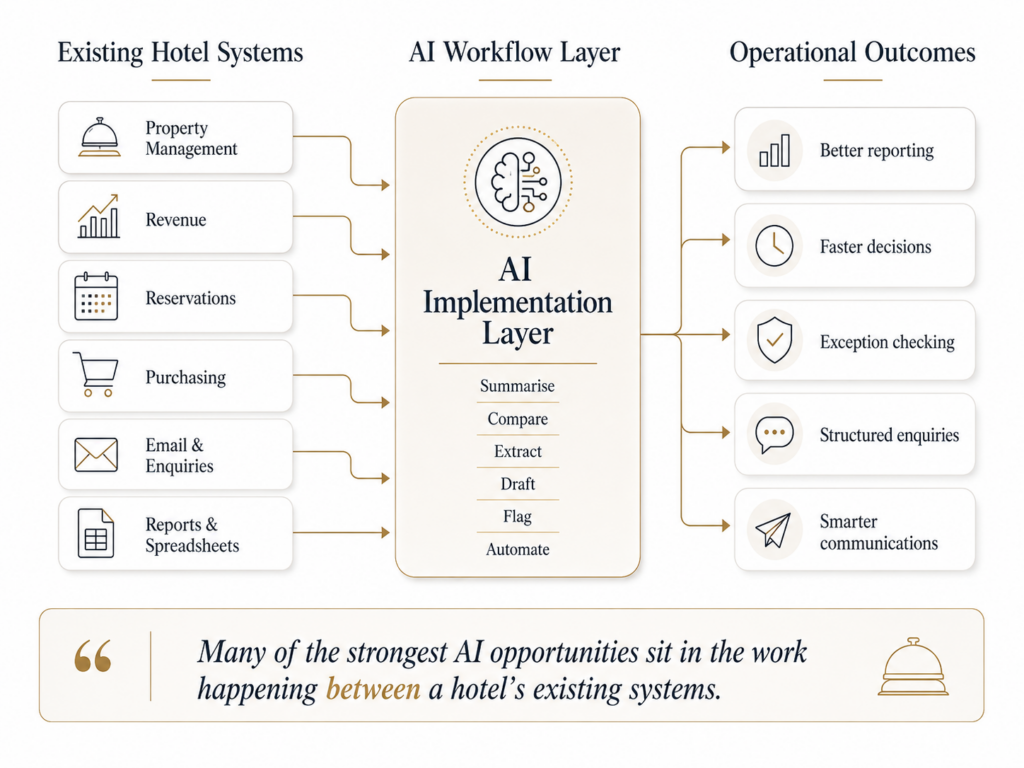
Manual reporting was one of the clearest examples. Revenue, Reservations, Housekeeping, Accounts and Marketing all had recurring processes where information was being pulled from one or more systems, reorganised or compared manually and then turned into a report or management view.
Email workload surfaced independently across several teams, including Reservations, Spa, Housekeeping and Sales and Events. The individual inboxes and messages were different, but the underlying requirement was similar: identify what matters, extract the relevant information, prioritise it and reduce the time spent dealing with repetitive communications.
We also found several processes where staff were manually checking information that already existed across different systems. One example within Reservations involved cross-referencing upcoming guest information across accommodation, dining, spa and previous correspondence so that discrepancies could be identified before arrival.
Staff in several departments were using free versions of ChatGPT for tasks such as drafting, summarising documents and analysing information. That gave us useful evidence of where AI was already proving valuable, while also highlighting the need to move useful individual practices into a more structured organisational setup.
Across all of this, a consistent theme emerged: many of the strongest opportunities sit in the work happening between the hotel’s existing systems.
From discovery to an AI implementation plan
Following the discovery session, we spent a couple of weeks analysing the departmental requirements and developing the Sopwell House AI Activation Plan.
This included identifying and prioritising use cases, assessing technical dependencies, reviewing the existing technology environment and separating opportunities that could progress quickly from those requiring further investigation.
The analysis showed that a long list of departmental requirements could be grouped into a smaller number of repeatable solution patterns, including:
- recurring report preparation and analysis
- inbox triage and communications support
- extracting structured information from enquiries and documents
- checking information across different sources
- document review and comparison
- SOP and internal knowledge support
- workflow automation between existing tools
This was important because the objective is not to build dozens of unrelated AI solutions.
Where several departments share the same underlying workflow pattern, the work done in one area can inform what is subsequently implemented elsewhere.
Alongside the implementation of specific workflows, we are also focused on building practical AI capability within the Sopwell House team. The aim is for people across the hotel to develop the confidence and proficiency to use AI beyond the solutions we implement together, so they can adapt and maintain existing workflows, identify new opportunities and use AI to solve new problems as they arise. Training and hands-on involvement therefore form an important part of the engagement, helping Sopwell House build an internal capability that can continue to develop as the technology and the needs of the hotel evolve.
Some of the opportunities we have identified
The strongest use cases were rooted in specific operational processes rather than broad ideas about how a hotel might use AI. The examples below sit at different stages of prioritisation and development.
Revenue
Our work with the Revenue team shows that much of the manual effort sits in bringing together information from systems such as Opera Cloud, Duetto, SynXis and other reporting platforms.
The data exists, but the exact views required for management reporting are not always produced in the required format.
We have identified opportunities around recurring rooms reporting, market segment comparisons, forecasting views and other processes where exports are repeatedly reshaped or combined before they become useful.
One of the early workflows being developed is based on an existing recurring market segment reporting process.
Reservations
Reservations emerged as another strong implementation area because it combines high email volumes, recurring reporting and detailed operational checking.
One of the workflows we’ve identified involves comparing upcoming guest information across several sources and surfacing discrepancies for the team to review.
The aim is to reduce the amount of information staff need to check manually while keeping them in control of the final decision.
Purchasing
Purchasing produced a broad set of opportunities around supplier comparison, price changes, purchase requests, document review, discrepancies and spend analysis.
The departmental work also demonstrated why these workflows need to be designed around real hotel operations.
A purchasing decision cannot simply be reduced to the lowest price. Product quality, pack size, yield, freshness and supplier reliability may all influence the correct decision.
That means the workflow needs to strengthen the team’s decision-making rather than oversimplify it.
Sales and Events
The Sales and Events discussions showed how much administrative work can happen before an event enquiry is ready to progress.
Enquiries arrive in different formats, yet the team repeatedly needs to extract the same core information, such as dates, guest numbers, room requirements, event type and contact details.
We identified structured enquiry intake as a foundation that could subsequently support response drafting, follow-up, proposals and internal event documentation.
Our approach to Opera Cloud and system integration
Opera Cloud is central to several of the workflows identified at Sopwell House, so one of the important questions during the project was how closely the AI layer needed to integrate with it.
We investigated the Oracle Hospitality Integration Platform and explored direct integration routes with specialist providers.
Our conclusion was that direct integration should not automatically be the first step.
For many workflows, the more relevant question is whether the operational process can first be proved using information that Opera Cloud already makes available through reports or exports.
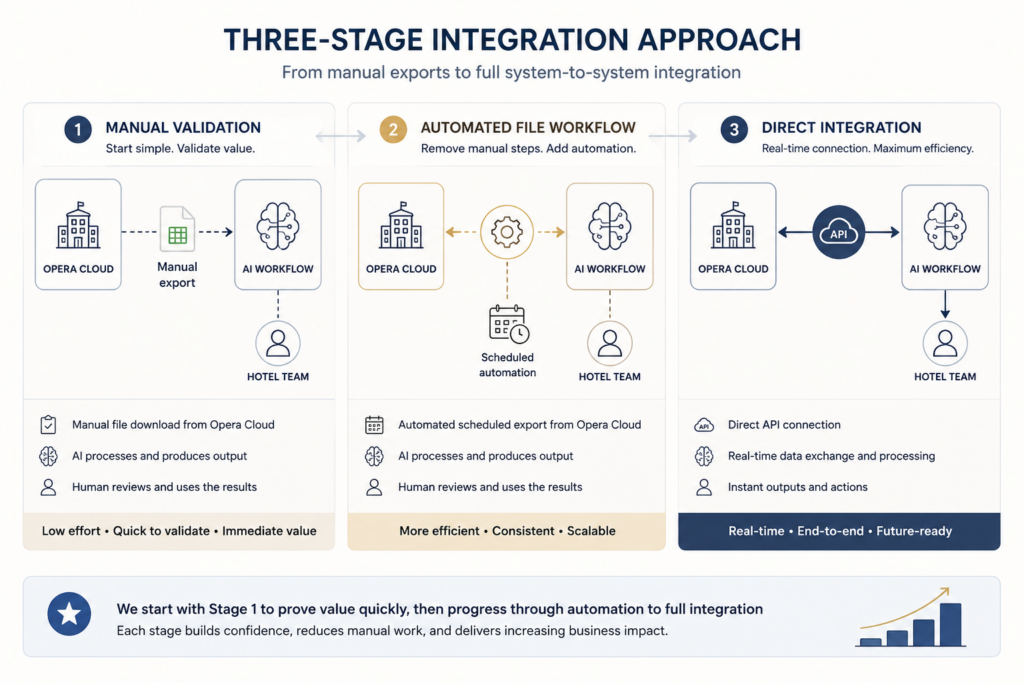
That led us to a three-stage implementation approach.
Stage one is validation. Existing reports or files are provided manually to the workflow so that we can establish whether the solution produces a genuinely useful result.
Stage two removes repeated manual file handling. Once the workflow is working and being used, tools such as Microsoft Power Automate can potentially automate the movement of information.
Stage three introduces deeper system integration where the value justifies the additional cost and complexity.
This approach allows the implementation to progress without making every useful AI workflow dependent on a major integration project from the outset.
It is one of the most important practical conclusions to emerge from the Sopwell House work so far.
What we are learning about AI implementation in hotels
The Sopwell House engagement is reinforcing several lessons about implementing AI inside a real hotel operation.
The first is that the biggest opportunities are not always inside the core hotel platforms themselves. They frequently appear where people are manually moving, comparing, interpreting or communicating the information those systems produce.
The second is that deeper technical integration does not always need to come first. Our work around Opera Cloud has shown that existing reports and exports can provide a practical route for validating a workflow before committing to a more complex integration.
The third is that departmental discovery matters. The strongest opportunities at Sopwell House have come from understanding exactly how teams work, where manual effort accumulates and which parts of those processes can realistically be improved.
That is very different from starting with a generic list of hotel AI use cases.
For us, the objective is to build an AI capability around the reality of the hotel operation, using existing systems wherever possible and adding automation or deeper integration where there is a clear reason to do so.
For a practical decision framework, read our guide to where to start with AI in an independent hotel.
AI consultancy for hotels and hospitality businesses
Digital Dialog works with hotels and hospitality businesses that want to move from fragmented AI experimentation towards a more structured approach to implementation.
Our work covers AI opportunity discovery, operational and technology assessment, use-case prioritisation, workflow design, implementation, integration planning and team training.
If you are exploring how AI could be applied across your hotel operation, find out more about Digital Dialog’s AI consultancy for hotels and hospitality businesses.
Frequently asked questions
How can hotels implement AI without complex system integrations from the outset?
Hotels can use a phased approach, starting with validation using existing reports and exports. Once the workflow is proven, file handling can be automated, moving to deeper system integration only when the value justifies the cost and complexity.
Which hotel departments have the strongest opportunities for AI implementation?
At Sopwell House, some of the strongest use cases emerged in Revenue, Reservations, Purchasing, and Sales and Events, although opportunities were identified across all nine departments involved in the discovery process. Many of the most interesting applications sit in the work happening between existing hotel systems.
How should a hotel prioritise AI opportunities?
Instead of starting with predetermined AI products, hotels should begin with departmental discovery. By understanding recurring tasks, manual processes, and where staff lose time, hotels can design around operational requirements first before determining the appropriate technology.