How Curated Greece Built Practical AI Capability Across Its DMC Team

Very efficient and understandable training session. They listened to us and knew our industry. They prepped our training very quickly and the result was great. The training was customised to our business which we appreciated. - Co-Founder, Curated Greece
At a Glance
Client: Curated Greece.
Sector: Boutique Destination Management Company (DMC).
Platforms Involved: Claude (paid accounts).
Business Problem: Employees already had access to Claude but identified their experience as basic to intermediate. The company needed to move beyond simple experimentation to get more practical value from their software investment by improving output reliability, everyday application, and workflow repeatability.
Work Undertaken: Digital Dialog designed and delivered a bespoke, two-part practical AI training programme. The sessions were shaped around the team’s actual DMC workflows rather than generic demonstrations, teaching them how to brief AI effectively, verify facts safely, and turn recurring tasks into structured, reusable processes.
Curated Greece had already adopted Claude across the business. Digital Dialog designed a practical AI training programme to help the team move from general AI use towards more confident, effective and repeatable use within their individual roles.
Curated Greece is a boutique destination management company specialising in bespoke travel experiences in Greece.
When the company approached Digital Dialog, generative AI was not new to the team. Curated Greece had already invested in paid Claude accounts, and employees were using AI for tasks including writing, email, documents, summarising and research.
The next challenge was getting more value from that investment.
AI confidence and experience varied across the team. Some people were using the technology frequently, while others were still relatively basic users. The opportunity was to help employees understand how to use AI more effectively within the work they already handled, and to begin identifying where recurring tasks could develop into more structured, reusable AI-assisted workflows.
Digital Dialog created a bespoke two-part training programme built around Curated Greece’s business, team and operational requirements rather than delivering a generic introduction to generative AI.
The challenge: moving beyond access to effective AI adoption
Buying AI licences is only one part of adoption.
Curated Greece had already made Claude available across the business. The question was how to help employees use it with greater confidence, consistency and judgement.
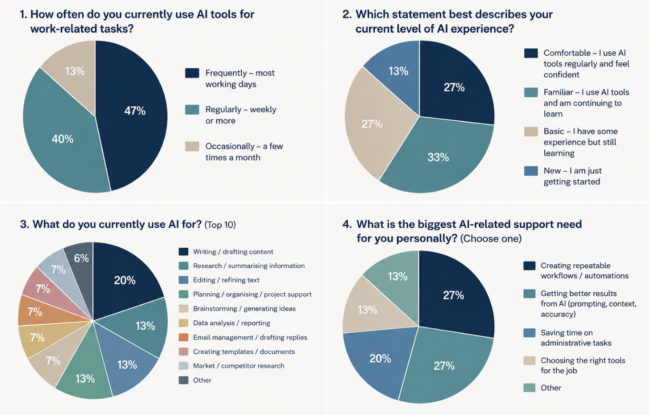
A pre-training survey showed that 87% of respondents were already using AI for work at least weekly, with almost half using it on most working days. At the same time, most of the team described their experience as basic to intermediate.
The strongest areas where employees wanted support were practical: getting better and more reliable outputs, applying AI to everyday work, creating repeatable workflows and understanding where the technology could genuinely save time.
This meant the programme needed to go beyond platform demonstrations.
The objective was to help employees understand how to brief AI properly, provide the right context, improve weak outputs, work safely with business information and recognise tasks that could become repeatable AI-assisted processes.
Designing AI training around the work of a DMC
The programme was shaped through discussions with the Curated Greece leadership team, a pre-training survey and examples of real workflows supplied by different parts of the organisation.
These covered responsibilities across client servicing, operations, accounting, marketing and management.
Potential applications included:
- reviewing and prioritising incoming information
- extracting relevant client and trip details
- assisting with itinerary changes
- drafting and checking supplier communications
- checking information across different sources
- researching hotels and destinations
- supporting internal administration
- identifying repetitive tasks that could become reusable workflows
The initial workflow discovery showed how broad the potential for AI was across the company.
Rather than trying to automate all of these processes during the programme, they were used to teach the team a more transferable skill: how to look at their own work and identify where AI could genuinely help.
That distinction matters for DMCs and travel companies. The useful question is rarely simply, “What can Claude or ChatGPT do?” It is, “Where could AI support the work our team actually performs every day?”
Teaching the team to brief AI more effectively
One of the foundations of the training was prompting, although we deliberately approached prompting as a briefing skill rather than a collection of formulas or tricks.
The team learned how AI output improves when the system receives useful context, including the actual source material, confirmed facts, intended audience, desired outcome, tone, constraints and examples of previous work.
They were also encouraged to treat the first response as a draft.
Instead of repeatedly starting again, employees learned how relatively short follow-up instructions could improve tone, length, structure, confidence or clarity once the AI already understood the task.
This is particularly important in a DMC environment, where apparently straightforward communications can carry operational implications. An AI-generated message should not accidentally promise something that has not been confirmed, introduce incorrect details or turn an assumption into a statement of fact.
Moving from one-off chats towards repeatable AI use
The programme then looked beyond individual prompts.
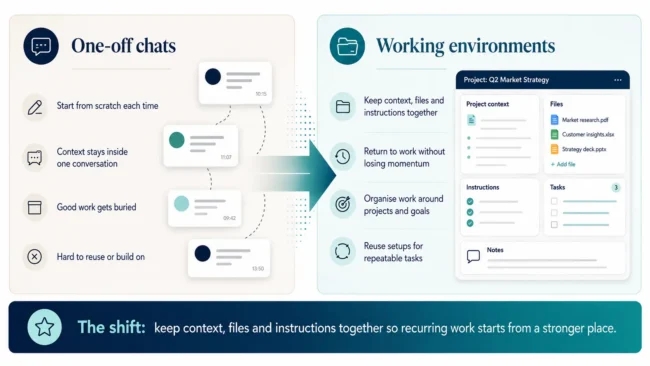
Curated Greece employees were introduced to different ways of organising recurring AI work, including Projects, reusable instructions, Skills and connected workflows.
The aim was not to make every task more complicated. It was to help people distinguish between different levels of AI use.
A simple one-off question may only need a normal chat. A recurring area of responsibility may benefit from a Project containing relevant instructions and reference material. A repeatable process may justify a reusable Skill or workflow.
The training encouraged employees to ask a simple question:
“If I do this regularly, should I continue starting from scratch every time?”
That progression, from isolated prompting towards reusable context and processes, was a central part of both the training and the detailed reference guide provided afterwards.
Applying the learning to real work between sessions
An important part of the programme happened between the two live sessions.
Rather than only looking at demonstrations, team members were asked to apply what they had learned to their own work.
One exercise involved taking a genuine guest or supplier communication and improving the way Claude was briefed. Participants were encouraged to provide stronger context, establish clear boundaries, specify the desired result and then refine the first response.
A second exercise asked employees to identify a recurring part of their work that might benefit from a reusable Task, Skill, Project or connected workflow.
The resulting examples covered areas such as guest and supplier communication, travel comparisons, multilingual client support, supplier knowledge, reservations and recurring internal processes.
Several participants also began identifying AI setups that could potentially be useful beyond a single task or individual user.
The important point was that the team was applying the principles to work they genuinely recognised, rather than practising against artificial examples created for a training course.
Building useful workflows without removing human judgement
Some of the opportunities identified during the programme involved information moving between email, travel documentation and internal business systems.
These can create valuable AI use cases, but they also require greater care.
If AI is helping draft an email, a person can review it before sending. If AI is extracting information that could affect an operational or financial record, the consequences of a mistake are higher.
Our recommended approach was therefore to introduce automation progressively.
For higher-risk workflows, an appropriate first step may be for AI to extract the relevant information and recommend an action for human approval, rather than immediately changing an official business record itself.
The training reinforced three principles for repeatable AI use: test workflows against real cases, maintain clear ownership of information and retain human review where the consequences of an error matter.
Using AI responsibly in travel operations
Responsible use formed an important part of the programme because travel companies routinely work with information where accuracy matters.
A fluent AI answer can still contain the wrong date, price, schedule, booking status or policy.
The team was therefore trained to distinguish between tasks where AI is primarily helping with language or structure and tasks where it is asserting facts that need to be checked.
The programme also covered privacy, sensitive client information, copyright, verification and situations where human judgement should remain central.
For a destination management company, using AI well means understanding both what the technology can accelerate and where an apparently small mistake could create an operational problem.
Expanding the team's view of what AI can do
Another objective was to help the team see AI as more than a writing assistant.
The programme explored how generative AI can support research, document analysis, information synthesis and recurring internal processes.
For a DMC, that might include analysing information about hotels and destinations, comparing options against a client brief, reviewing documents, organising internal knowledge or finding patterns across information the business already holds.
The broader goal was to give employees enough understanding and confidence to identify relevant AI opportunities within their own responsibilities rather than relying on a fixed list of prescribed use cases.
What changed?
There was clear evidence during the programme that employees were beginning to apply the techniques independently.
Between the sessions, participants used the prompting approach with genuine work, refined outputs using their own professional judgement and identified recurring tasks that could potentially become reusable AI workflows. Some participants also began testing those ideas against real examples.
The immediate progression was from general AI use towards more deliberate, structured and repeatable use within individual roles.
We are currently gathering further feedback and real-world usage data following the training. As more evidence becomes available, we will update this case study with additional examples of adoption, time savings and workflow improvements where appropriate.
What can other destination management companies learn from Curated Greece?
Curated Greece illustrates an increasingly common stage of AI adoption.
A travel company may already have Claude, ChatGPT or another generative AI platform. Employees may already be using it regularly. That does not necessarily mean the organisation is getting the full value from the technology.
The next stage is often about capability.
Employees need to understand how to provide AI with the right context, recognise unreliable output, preserve their own judgement and tone of voice, and identify repetitive work that could become more structured.
For destination management companies in particular, training becomes significantly more relevant when it is built around the work the team actually performs: enquiries, proposals, itineraries, research, guest communications, supplier relationships, reservations and operations.
That was the approach taken with Curated Greece.
Practical AI training for DMCs and travel companies at every stage of AI adoption
Digital Dialog provides practical AI training and consultancy for travel, tourism and hospitality organisations at every stage of AI maturity.
Some clients come to us before they have adopted generative AI and need help understanding the technology, choosing appropriate tools and building confidence across their team.
Others, like Curated Greece, have already invested in AI and want to improve adoption, consistency and the practical value they get from it.
Our training is shaped around the organisation’s starting point, the work its people actually do and the areas where AI can create genuine business value.
Whether your team is completely new to AI or already using tools such as Claude or ChatGPT, Digital Dialog can design a practical training programme around the realities of your travel or tourism business.
Frequently asked questions
Can AI training help a DMC that already uses Claude or ChatGPT?
Yes. Once employees already have access to generative AI, training can focus on getting more value from it: stronger prompting, better context, more reliable outputs, reusable workflows, shared standards and understanding which recurring tasks could benefit from a more structured AI setup.
Does Digital Dialog also provide AI training for beginners?
Yes. Digital Dialog works with travel, tourism and hospitality organisations at different stages of AI adoption. Training can begin with the fundamentals for teams that have little or no experience, or focus on more advanced practical adoption for organisations already using generative AI.
How was the Curated Greece AI training customised?
Digital Dialog used leadership discussions, a pre-training survey and workflow examples from different parts of the organisation to shape the programme around Curated Greece’s own responsibilities and working practices. The sessions then used practical examples and exercises relevant to the team’s real work.
Was the programme only about Claude?
Claude was the main platform because it was already being used by Curated Greece. The programme also covered wider generative AI principles that apply across tools, with other platforms referenced where useful.
What AI use cases are relevant to destination management companies?
Relevant applications can include itinerary support, destination and hotel research, guest and supplier communications, document analysis, internal handovers, operational checking, information extraction and recurring administrative workflows. The right use cases depend on how the individual DMC operates.